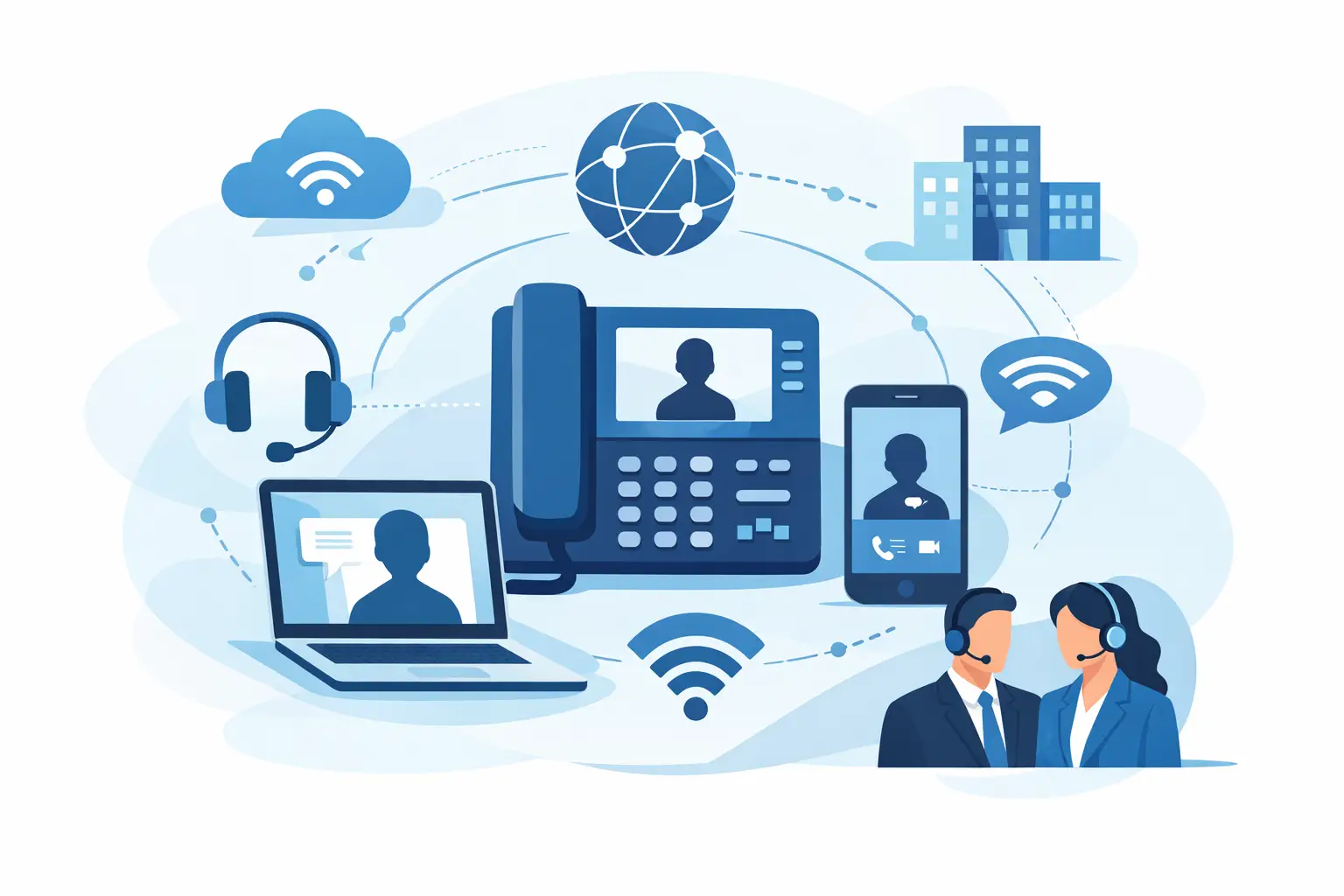
A missed call to a customer used to mean checking whether the line was engaged, whether the handset was faulty, or whether someone simply could not get to the desk in time. With modern phone systems, the question is different: how does VoIP work for business, and why are so many firms replacing traditional lines with it? For most small and mid-sized organisations, the answer comes down to flexibility, clearer control, and a phone system that fits the way people actually work.
How does VoIP work for business day-to-day?
VoIP stands for Voice over Internet Protocol. In plain English, it means your phone calls travel over your internet connection rather than through old-style analogue or ISDN phone lines. When someone in your business speaks into a handset, headset, or mobile app, their voice is converted into digital data, sent across the internet, and turned back into audio for the person on the other end.
That process happens very quickly, so the call feels like a normal conversation. To the user, it is still just a phone call. The difference is in the infrastructure behind it. Instead of relying on fixed telephone circuits at each premises, the system uses your data connection and cloud-based call handling.
For a business, that changes more than the cabling. It changes how calls are routed, how staff answer them, and how easily the system can grow with the company.
What happens when a VoIP call is made?
A business VoIP call usually starts from a desk phone, cordless handset, laptop softphone, or smartphone app. The user dials a number as normal. The VoIP platform then processes that request and directs the call through the internet to the recipient.
If the call is going to another VoIP user on the same system, it may stay entirely within that digital environment. If it is going to a mobile or landline number, the call is passed through the provider’s network and connected to the public telephone network where needed.
Incoming calls work in much the same way. A customer dials your business number, the hosted phone system receives the call, checks the rules you have set up, and sends it to the right destination. That could be a receptionist, a sales queue, an individual extension, a hunt group, or a mobile device if someone is away from the office.
This is one of the key reasons businesses move to VoIP. The phone number is no longer tied so tightly to one physical line in one room. The number belongs to the business, and the system decides where the call should go.
The main parts of a business VoIP system
Although VoIP can sound technical, the main components are straightforward. You need a reliable internet connection, the right devices, and a phone platform to manage calls.
The internet connection matters because voice traffic now shares the same underlying network as many other business services. If the broadband is unstable or heavily congested, call quality can suffer. That does not mean VoIP is unreliable by default. It means the wider setup needs to be planned properly.
The devices can be traditional-looking IP handsets, cordless units for more mobile teams, or software apps on PCs and mobiles. Some businesses prefer desk phones because they feel familiar and easy to use. Others lean towards softphones because they suit hybrid working and reduce hardware costs. In many cases, the best answer is a mix.
The phone platform is often cloud-hosted. This is where features such as voicemail, call menus, extension management, call recording, time-based routing, and reporting are controlled. Instead of maintaining a bulky on-site PBX, businesses can access these functions through a hosted service that is updated and managed more easily.
Why VoIP suits modern business use
Traditional telephony was built around fixed locations. Most businesses no longer operate that way. Staff move between offices, work from home, travel to client sites, and use a mixture of desktop and mobile devices throughout the day.
VoIP supports that flexibility well because the system is not confined to one building in the same way older phone setups were. A member of staff can answer their office extension from a laptop at home. A manager can transfer a call from a mobile app. A multi-site business can present one consistent phone presence even when teams are spread across different locations.
That does not just help convenience. It can improve customer experience. Calls can be answered faster, passed to the right person more easily, and handled in a more organised way when the phone system reflects how the business actually works.
How call quality and reliability are managed
One of the first questions businesses ask is whether VoIP is as reliable as a traditional line. The honest answer is that it depends on the quality of the underlying connection and how well the network is configured.
A good VoIP setup needs enough bandwidth, but raw speed is only part of the picture. Stability, latency, and network design also matter. If large file transfers, guest Wi-Fi traffic, and voice calls are all competing badly on the same network, users may notice jitter, delay, or dropped audio.
This is why proper assessment matters before installation. In many cases, simple improvements such as traffic prioritisation, better switching, stronger Wi-Fi design, or more suitable broadband can make a major difference. Businesses often assume phone quality is only about the handset, when in reality the wider network environment has a big effect.
There is also the question of resilience. If your internet goes down, your phone service can be affected. The practical response is to plan for that rather than ignore it. Options may include backup connectivity, call forwarding rules, mobile app access, or broader business continuity arrangements. For firms that rely heavily on incoming calls, this part deserves proper attention.
Costs, savings, and where expectations should be realistic
VoIP is often described as cheaper than older phone systems, and in many cases that is true. It can reduce line rental costs, make scaling easier, and avoid some of the maintenance burden associated with ageing on-site systems. Adding new users or features is often simpler too.
That said, the cheapest option is not always the best value. If a business chooses a poor platform, unreliable connectivity, or minimal support, any headline savings can disappear quickly in lost time and frustrated staff. The real benefit comes from matching the system to the organisation’s needs and making sure it is properly installed and supported.
For some firms, the value is mainly financial. For others, it is operational. Better call handling, easier administration, and improved flexibility can matter just as much as monthly cost reductions.
How does VoIP work for business day to day?
In day-to-day use, most staff adapt to VoIP very quickly. They still make and receive calls in a familiar way, but with more options available. An office manager might update opening hours in the call menu without waiting for engineering work. A director might review missed calls and voicemail remotely. A sales team might see whether colleagues are available before transferring a call.
Because the system is software-driven, changes are usually quicker than they were with traditional telephony. New users can be added more easily. Numbers can be reassigned. Call flows can be adjusted to suit seasonal demand, staffing changes, or office moves.
This is particularly useful for growing businesses and organisations with more than one site. Instead of treating each location as a separate phone island, VoIP allows a more joined-up approach.
Is VoIP right for every business?
Not automatically. Some environments have more complex requirements than others. A warehouse, surgery, school, or busy professional office may each need different handset types, call routing rules, coverage considerations, and resilience planning. Businesses with poor connectivity may need network improvements before a VoIP rollout makes sense.
There is also the people side. Even simple systems benefit from good setup, clear user guidance, and sensible support after go-live. A phone system is part of daily operations, so it needs to work reliably without becoming another thing the office has to wrestle with.
That is why a consultative approach matters. The right system is rarely the one with the longest feature list. It is the one that fits the business, supports staff properly, and delivers dependable performance without unnecessary extras. For businesses across North Wales, The Wirral, and Cheshire, that local, practical support is often the difference between a phone system that looks good on paper and one that genuinely helps the business run better.
VoIP works best when it is treated as part of the wider business infrastructure, not just a box-ticking phone replacement. Get the connection, setup, and support right, and it becomes a more flexible way to keep your team reachable and your customers looked after.