A missed call can mean a missed order, delayed instruction or frustrated customer. That is why the cloud PBX vs onsite PBX decision is about more than phone handsets. It affects how easily your team can work across sites, from home and on the road, as well as how much responsibility your business takes for the underlying system.
For many small and mid-sized businesses, cloud telephony has become the default choice. However, an onsite PBX can still be the right answer where there are specific control, connectivity or operational requirements. The best option depends on how your business works, not on which technology sounds newest.
Cloud PBX vs onsite PBX: the key difference
A PBX, or private branch exchange, is the system that connects internal extensions, routes calls and provides features such as voicemail, call transfers, queues and automated greetings.
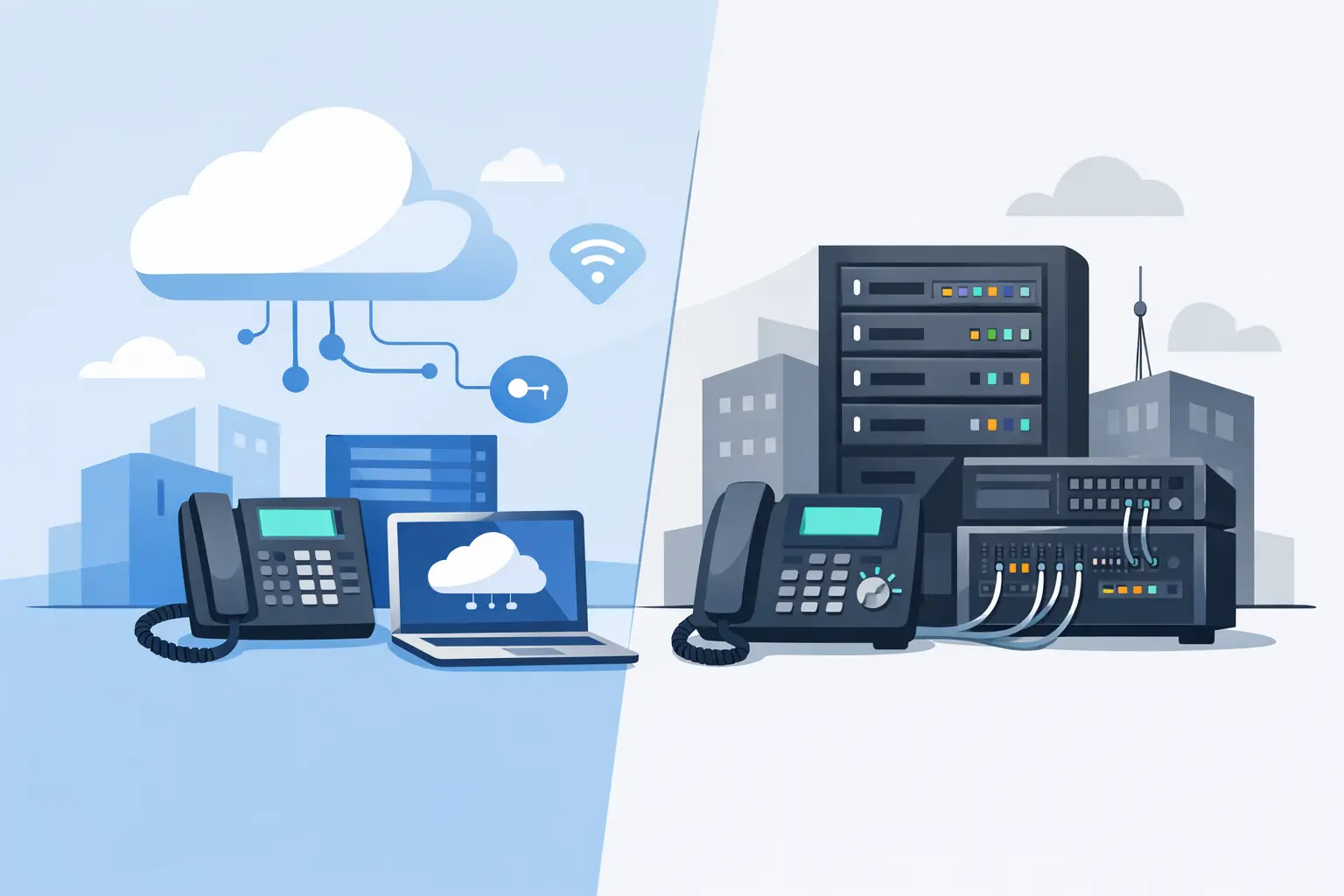
With an onsite PBX, the main phone system runs on equipment installed at your premises. Your business owns or leases the server and is responsible for providing a suitable location, power, network connection and ongoing maintenance arrangement. Calls may use traditional lines, SIP trunks or a mixture of both.
A cloud PBX is hosted in a supplier’s data centre or cloud platform rather than in your comms cupboard. Your phones, computers and mobile apps connect to it over the internet. The core system is managed remotely, while users can normally make and receive calls wherever they have a reliable connection.
Both models can provide professional business telephony. The practical difference is where the system sits, who maintains it and how readily it can adapt when your team or locations change.
Cost: capital spend versus predictable monthly charges
An onsite PBX usually involves a larger upfront investment. There may be costs for the server, licences, installation, configuration, handsets and network improvements. It can be a sensible long-term arrangement for a stable organisation with a clear budget for equipment and a reason to keep key services on site.
Cloud PBX services generally spread costs into a monthly charge per user or extension. This reduces the initial outlay and makes budgeting simpler, particularly for businesses replacing an ageing system or moving offices. Handsets, setup and specialist features may still create one-off costs, so it is worth looking beyond the headline monthly figure.
Lower upfront cost does not automatically mean lower total cost. Over several years, subscription fees can add up. Conversely, onsite equipment eventually needs replacement, software updates and support. A fair comparison should include the expected life of the system, call charges, maintenance, licences, resilience measures and the time your staff would spend managing it.
Flexibility for hybrid teams and changing premises
Cloud systems are often easier to scale. Adding a new colleague, temporary extension or additional site can usually be done without installing another PBX server. Staff can use a desk phone in the office, a softphone on a laptop or an app on a business mobile, often with the same extension and caller identity.
That flexibility is useful for businesses with home workers, field staff, seasonal demand or offices across North Wales, Cheshire and The Wirral. It also helps when a move happens faster than expected. Provided connectivity is ready, the telephone system can often be brought across without the disruption of relocating a physical PBX.
An onsite PBX can support multiple locations too, but it normally needs more planning. Remote access, secure network links and additional hardware may be required. For a single-site business with a settled headcount, this may not matter. For an organisation that changes regularly, it can become an unnecessary constraint.
Reliability depends on the whole setup
There is a common assumption that an onsite phone system is always more reliable because the equipment is in the building. In practice, it is only as dependable as the power, local network, telephone connection and support behind it. A power cut, failed router or damaged cable can still stop calls.
Cloud PBX platforms are usually hosted on resilient infrastructure, often with redundancy that would be costly for a smaller business to create on its own. But cloud calling depends on internet connectivity at each location. If the broadband fails and there is no backup connection or call-forwarding plan, desk phones may be affected.
The answer is not to avoid cloud telephony. It is to design it properly. A dependable setup may include business-grade broadband, suitable Wi-Fi and switching, a 4G or 5G failover service, and clear rules for forwarding calls to mobile devices during an outage. Voice traffic should also be considered when assessing broadband capacity, especially in busy offices.
For an onsite PBX, resilience may involve an uninterruptible power supply, replacement hardware arrangements, monitored connectivity and a recovery plan if the server fails. Neither option is automatically resilient without the right preparation.
Control, security and integration
An onsite PBX gives an organisation direct control over the equipment and its local configuration. This can appeal to businesses with unusual workflows, legacy integrations or policies that require services to remain within their own environment. It may also suit sites where internet connectivity is poor or unavailable.
Cloud platforms can still offer substantial control through web-based administration, user permissions, call recording policies and detailed reporting. They commonly integrate well with customer relationship management systems, Microsoft 365 tools and other business applications. The right platform can reduce manual call handling by showing customer information, directing calls by department or sending voicemail messages to email.
Security should be considered carefully in either model. Weak passwords, poorly configured remote access and unpatched software can expose phone systems to misuse and unexpected call charges. A managed provider should apply sensible access controls, keep software current and monitor the system for unusual activity. The technology matters, but day-to-day management matters just as much.
Support is often the deciding factor
A telephone system can look straightforward until something changes. A new starter needs an extension, a call queue needs adjusting, an internet fault affects calls, or a handset stops working during a busy period. Businesses should establish who will answer, how quickly they can respond and whether the provider supports the network as well as the phones.
With an onsite PBX, your support partner may need remote access or an engineer visit to diagnose hardware issues. You also need clarity on ownership: who holds administrator passwords, software licences, backups and configuration records?
With a cloud PBX, many changes can be made remotely, but service quality still relies on the local network, router and handsets. A supplier that understands both IT infrastructure and telephony can investigate the full path of a problem rather than passing responsibility between separate providers.
For businesses that do not have an in-house IT team, this is often more valuable than choosing a system based on a feature list alone. CATalyst Systems plans, installs and supports the connected services around business telephony, helping customers avoid the gaps that can arise when broadband, Wi-Fi, IT and phones are supplied separately.
When each option is likely to suit
A cloud PBX is often a good fit when your business needs to support hybrid working, expects to grow or change locations, wants to minimise upfront spending, or needs staff to answer business calls from more than one device. It is also attractive where remote administration and modern call-handling features will save time.
An onsite PBX may be worth considering when you have a single, established site, a strong reason to retain local control, specialist integrations or unreliable connectivity that cannot yet be improved. It can also work well where an existing, well-maintained system still meets operational needs and replacement would offer little real benefit.
Do not assume that keeping the current system is always cheaper. If it is difficult to support, relies on obsolete lines or cannot accommodate changing work patterns, its hidden cost may be greater than the price of replacement. Equally, do not move to the cloud simply because it is fashionable if your connectivity, security and operational requirements have not been assessed.
Choosing a phone system that will still work next year
Start with your call flows. Consider who answers incoming calls, where staff work, how customers reach the right person and what should happen when nobody is available. Then review your internet connection, mobile coverage, network equipment and any applications the system needs to work with.
Ask potential suppliers to explain not only the recommended PBX, but also what happens during a broadband outage, how numbers are transferred, what support covers and how costs change as users are added or removed. Straight answers at this stage prevent unwelcome surprises later.
The right phone system should make it easier for customers to reach you and easier for staff to respond. Whether that means a cloud platform or an onsite PBX, choose the arrangement that supports the way your business operates now while leaving room for the changes you can reasonably expect.