When calls are missed, transferred badly or dropped at a busy moment, the problem is rarely just the phone. It affects customer confidence, staff productivity and the smooth running of the day. A business VoIP phone system is often the right fix, but only when it is chosen around how your organisation actually works rather than a generic feature list.
For many small and mid-sized businesses, the appeal is clear. VoIP, or Voice over Internet Protocol, routes calls over your internet connection instead of traditional phone lines. That can reduce line rental costs, make it easier to support home and mobile workers, and give you more flexibility as your team grows. The difficulty is not understanding what VoIP is. It is deciding which setup will be dependable, cost-effective and sensible for your business.
What a business VoIP phone system should really deliver
A good phone system should help people reach the right person quickly, keep teams connected across locations and give your business room to change without replacing everything a few years later. Those are the practical outcomes most organisations care about.
That means the right system is not always the one with the longest list of functions. Some businesses need call recording, CRM integration and advanced reporting. Others simply need clear call quality, reliable handsets, voicemail to email and the ability to move calls between desks, mobiles and remote staff without fuss. Paying for features nobody uses is no better than staying with an outdated setup that holds you back.
This is where a consultative approach matters. The starting point should be how many users you have, how calls flow through the business, whether you operate from one site or several, and how much support you want after installation. The best-fit solution often comes from answering these operational questions first.
Why more businesses are moving away from traditional phone lines
The move to VoIP is not simply about keeping up with technology. For many businesses, it is a practical response to how work has changed. Staff are no longer tied to a single desk in a single office, and customers still expect a professional experience whenever they call.
A traditional PBX can be reliable, but it is usually less flexible and can be more awkward to scale. Adding users, changing call routing or supporting remote teams may require more cost and more compromise. A business VoIP phone system usually makes these changes easier. New users can often be added quickly, numbers can be retained, and features can be managed with far less disruption.
There is also the question of futureproofing. As older telephony infrastructure is phased out, businesses that delay change may end up making rushed decisions later. Planning the move properly now tends to produce better results than waiting until a legacy service becomes a problem.
The main choices you need to make
One of the first decisions is whether you want a fully hosted cloud phone system or a more tailored hybrid arrangement. In many cases, hosted VoIP is the best fit for SMEs because it removes the need for maintaining on-site phone system hardware and makes support, updates and scaling more straightforward.
That said, it depends on the business. If you have a more complex setup, site-specific requirements or a need to integrate with other systems already in place, the answer may not be completely off-the-shelf. A warehouse, a professional office and a multi-site care provider may all need different call handling, devices and connectivity considerations.
Hardware is another factor. Some businesses want traditional desk phones because they suit reception areas, meeting rooms and staff who spend much of the day on calls. Others prefer softphone apps on laptops and mobiles. In practice, many organisations benefit from a mix of both. The important point is to choose the devices around the role, not the other way round.
Connectivity matters more than many businesses expect
VoIP depends on the quality and stability of your internet connection. That does not mean every business needs a costly leased line, but it does mean connectivity should be assessed properly before the system is installed.
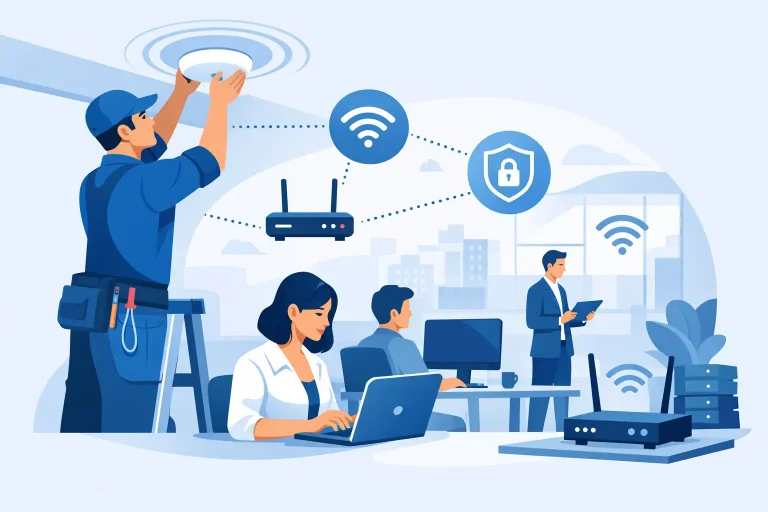
If your broadband is unreliable, heavily contended or already stretched by cloud applications and large file transfers, voice quality can suffer. Calls may sound delayed, distorted or unstable. That is why any sensible VoIP project should look at the wider network, including router performance, internal cabling, Wi-Fi coverage where relevant and how voice traffic will be prioritised.
This is often where businesses benefit from working with a provider that understands telephony and wider IT infrastructure together. Phones do not operate in isolation. A well-designed business VoIP phone system is usually part of a broader communications setup that includes broadband, networking and user support.
Features worth paying for and features that can wait
There are some features that genuinely improve day-to-day operations. Auto attendant menus help direct calls efficiently. Hunt groups make it easier for teams to answer shared enquiries. Voicemail to email helps staff pick up messages quickly. Call reporting can be valuable for busy customer-facing teams, especially when managers need visibility of missed calls or response times.
Other features are more situational. Call recording can be useful for compliance, training or dispute resolution, but not every organisation needs it. CRM integration can save time, but only if your team already uses that platform consistently. Analytics dashboards may look impressive, yet they offer limited value if nobody reviews them.
A sensible provider should talk through what will be useful now, what may become useful later, and what would simply add cost. That matters because the cheapest system is not always best value, but neither is the most feature-heavy one.
Support is part of the system
One of the most overlooked parts of choosing VoIP is support after go-live. Installation is important, but so is what happens when a handset fails, a user needs to be added, a call flow needs changing or an issue appears during a busy working day.
For many SMEs, responsive support is just as important as the technology itself. Dealing with multiple suppliers can slow everything down, especially if telephony, broadband and internal IT all affect the same problem. A provider that can plan, install, maintain and support the whole setup is often easier to work with and more accountable when something needs attention.
This is particularly relevant for organisations that do not have in-house IT resource. A business owner or office manager should not have to spend half a day trying to work out whether a fault sits with the phones, the network or the connection.
Cost should be judged over time, not just upfront
VoIP can offer clear savings, but the real picture depends on how the system is designed. Monthly per-user pricing is attractive because it is predictable, but businesses should still ask what is included. Handsets, call bundles, support, installation, training and changes after setup can all affect the total cost.
There is also a difference between a low-cost package and a well-supported service. If a cheaper provider leaves you with patchy onboarding, poor documentation and slow fault response, the savings can disappear quickly in lost time and frustration.
For growing businesses, flexibility has value too. Being able to add users, support a new site or enable remote working without replacing the whole system can save a great deal over the longer term.
Questions worth asking before you choose
Before committing to any provider, it is worth asking how the system will cope with your specific way of working. How will calls be handled if staff work from home part of the week? What happens if your internet service fails? How are number porting and installation managed? Who provides support, and when? What training is included for your team?
The quality of the answers usually tells you a lot. A good provider will explain the trade-offs clearly, not rush you into a standard package and not recommend extras that do little for your business. That practical, honest approach is often the difference between a system that simply functions and one that genuinely supports the way you work.
For businesses across North Wales, The Wirral and Cheshire, that local and ongoing support can be especially valuable. CATalyst Systems works with organisations that want dependable communications without unnecessary complexity, and that is often exactly what a phone system decision should come down to.
A phone system should make your day easier, not add another layer of admin or uncertainty. If you choose with your users, connectivity and support needs in mind, VoIP can be a straightforward improvement that pays back in reliability as much as cost.